Entering Indonesia is a sequence of decisions. Each one narrows the next: your business lines decide whether you can own 100% of a company, your entry route decides how much capital you need, and your role decides which stay permit you hold. Taking them in order avoids expensive changes later.
The eight steps at a glance
1. Test the opportunity
Before committing capital, answer the questions an investment committee will ask: how large the market is and where demand sits, who already competes and at what prices, what it costs to operate, and what the regulatory limits are. Evidence at this stage is cheaper than a correction after incorporation.
2. Check your business lines
Every activity is classified under KBLI, Indonesia's business classification. Most business lines are open to 100% foreign ownership under Presidential Regulation No. 10 of 2021, as amended. Some are capped, reserved for cooperatives and small businesses, or tied to partnership requirements, and some regions restrict new foreign investment in specific lines. Check every code you plan to use before you agree a structure with anyone.
3. Choose your entry route
| Route |
What it allows |
Best for |
Main trade-off |
| Distributor or agent |
Sell through a local company without your own entity |
Testing demand with low commitment |
Less control, and you depend on the partner |
| Representative office (KPPA) |
Promote, research and coordinate for the parent company |
Building relationships before trading |
Cannot earn revenue in Indonesia |
| PT PMA |
Trade, invoice, hire, hold licences and assets |
Committed, long-term operations |
At least IDR 2.5 billion paid-up capital and an investment plan above IDR 10 billion per business line and location |
| Joint venture |
Share a PT PMA with an Indonesian partner |
Sectors with ownership caps, or where a partner brings licences or customers |
Shared control and the need for strong agreements |
Many companies combine routes: a distributor first, then a PT PMA once sales justify it.
4. Choose a location
The right city depends on your customers, suppliers and workforce. Your address must also match the zoning for your activity, and most manufacturing must be located in an industrial estate. Check zoning and licensing conditions before you sign a lease.
5. Find and vet partners
Distributors, suppliers and joint-venture partners can give you customers and capacity quickly. Check each candidate's company registration, licences, business lines, trademarks and court records before you commit, and put agreements in Indonesian as well as English.
6. Set up the company
For a PT PMA, settle the business lines, shareholders, capital and directors before the deed is signed. Incorporation and the business identification number (NIB) usually take a few weeks once documents and decisions are ready. Budget for the first two years of running costs as well as setup.
7. Permits and people
A shareholder with shares worth at least IDR 10 billion in their own name can hold an investor KITAS. Directors and staff below that threshold need a working KITAS, which requires Ministry of Manpower approval and carries a foreign worker fee. Family members follow on dependent permits.
8. Stay compliant from day one
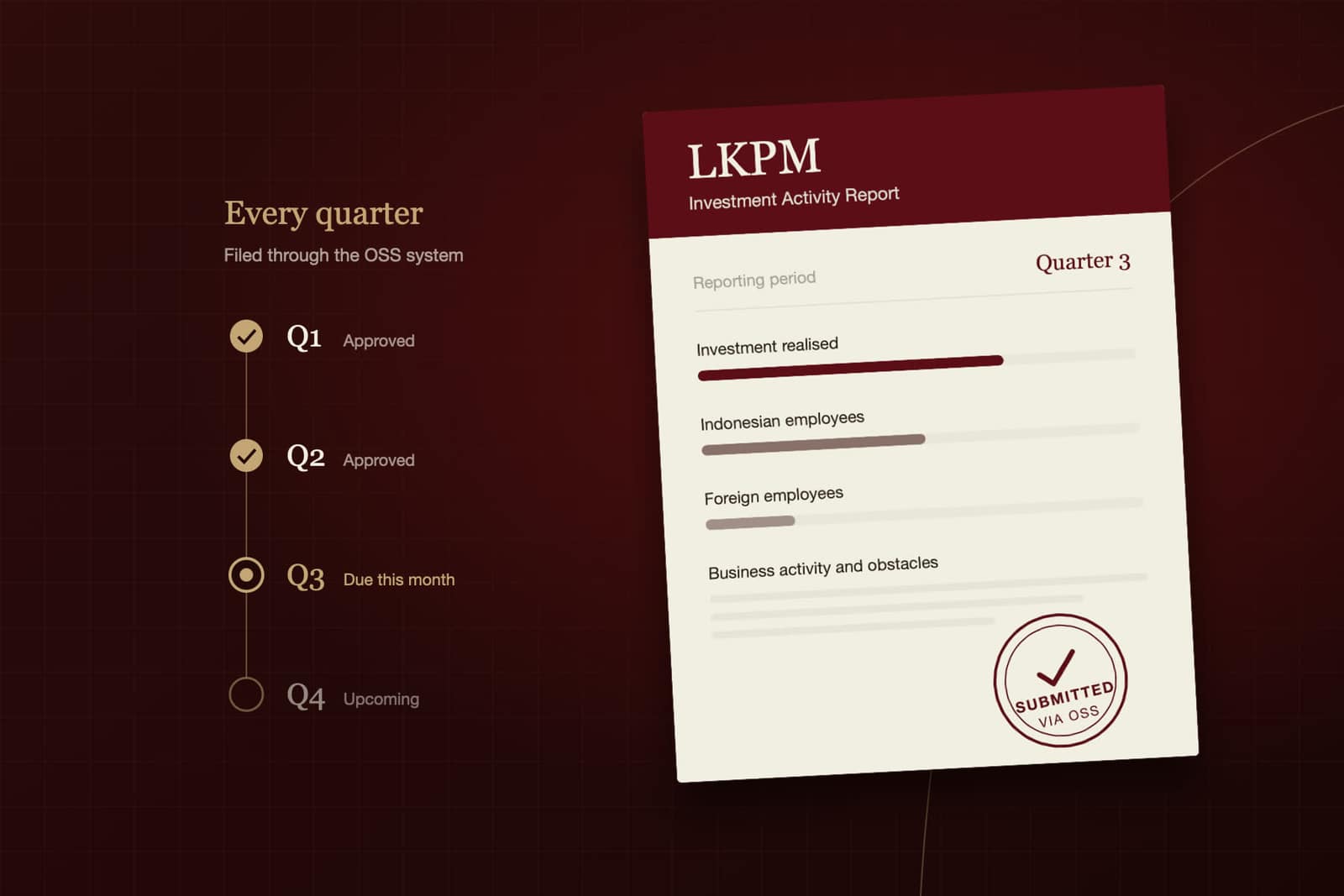
Monthly tax, BPJS contributions, quarterly LKPM reports and the annual tax return and shareholders' meeting all apply from the start, even before revenue. Missing LKPM reports leads to warnings and, eventually, suspension and revocation of the business licence.
Protect your brand early
Indonesia is first-to-file: trademark rights come from registration in Indonesia, not from earlier use abroad. Register before you appoint a distributor or launch. Our Legal & Corporate services include trademark registration.
Where to start
Take our two-minute market entry readiness check to see which steps you have covered, or book a consultation and we will map the route with you.
This note is general information, not legal or tax advice. Regulations in Indonesia change often, so confirm the current requirements for your situation before acting. How we research and review our guides.